GEOTECHNICALENGINEERING
BURLINGTON
HomeSlopes & WallsRetaining wall design

Retaining Wall Design in Burlington: Geotechnical Factors That Shape Every Project

Geotechnical engineering with regional judgment.

LEARN MORE

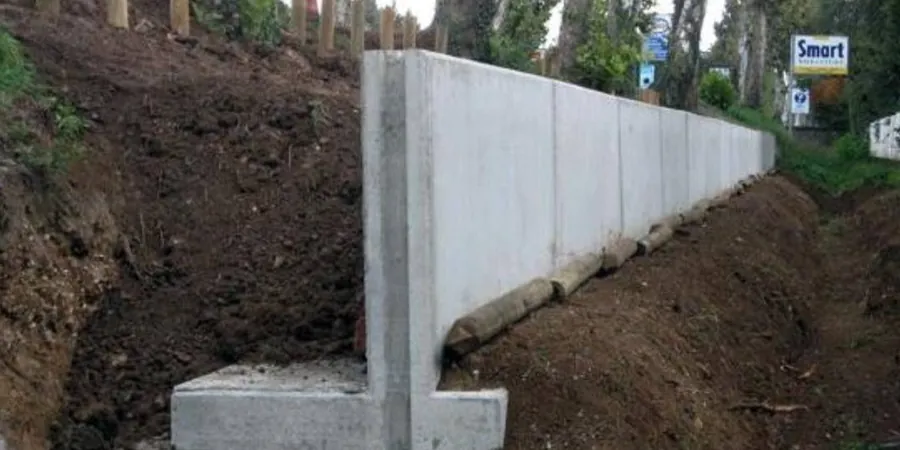
In Burlington, a retaining wall rarely sits on textbook soil. The escarpment geology that defines the Niagara Escarpment cuts right through the region, leaving many residential and commercial lots with Queenston shale at shallow depth, often mantled by Halton Till. When a developer on Lakeshore Road plans a walkout basement, or a homeowner near Tyandaga needs a tiered garden wall, the design conversation begins with what lies beneath the frost line—typically 1.2 metres in this part of Ontario. A retaining wall here must handle not just lateral earth pressure but also seasonal groundwater perched atop the shale, which swells slightly with moisture and can exert unexpected surcharge on the wall stem. Our team integrates data from SPT drilling to quantify the till consistency before selecting a cantilever or gravity wall geometry, ensuring the factor of safety against overturning meets the NBCC requirements for the site class assigned to the property.

Queenston shale at 1.2 metres depth changes the entire retaining wall design equation—it demands a frost-protected key and a drainage system that accounts for the perched water table on the escarpment slope.
Our service areas

Methodology and scope

The engineering workflow for retaining wall design in Burlington starts with a detailed stratigraphic profile, often derived from Shelby tube samples and standard penetration tests. A typical Queenston shale profile shows an RQD below 40% in the weathered upper zone, which directly influences the passive resistance available at the toe. We model the wall in limit equilibrium software using drained shear strength parameters—effective cohesion c' around 5 kPa for the till and a friction angle phi' of 32 to 35 degrees, depending on the silt content. For taller walls exceeding 3 metres, a key design parameter is the heel width relative to the stem height, especially when the backfill is a free-draining granular material compacted to 95% of standard Proctor density. The in-situ permeability of the native till governs the drainage detail: a continuous weeping tile behind the stem, wrapped in clear stone and filter fabric, is standard practice to prevent hydrostatic buildup during the spring thaw when the ground is still partially frozen but surface melt is active. Cantilever walls in Burlington rarely exceed 4.5 metres in height before a tieback or a mechanically stabilized earth (MSE) alternative becomes more economical.
Retaining Wall Design in Burlington: Geotechnical Factors That Shape Every Project
Technical reference — Burlington

Local considerations

A mistake we encounter in Burlington is treating a retaining wall as a standalone structural element, disconnected from the slope hydrology above it. When a contractor installs a segmental block wall without a continuous drainage blanket behind it, and the lot above drains toward the wall, the first heavy rain after construction saturates the backfill. The resulting hydrostatic pressure can double the lateral load the wall was designed for, leading to bulging or outright collapse at the mid-height. Another failure mode is keying a wall into weathered shale without recognizing that the shale deteriorates rapidly upon exposure to air and water, reducing the passive wedge strength within a single freeze-thaw cycle. The solution is a site-specific retaining wall design that models the groundwater profile measured during the wettest month—typically April in Burlington—and specifies a free-draining backfill zone that extends at least 600 mm behind the stem, connected to a positive outlet at the toe.

Need a geotechnical assessment?

Reply within 24h.

Email: contact@geotechnicalengineering.co

Explanatory video

Applicable standards

NBCC 2020 – Division B, Part 4 (Structural Design), CSA A23.3-19 – Design of Concrete Structures, ASTM D698-12(2021) – Standard Proctor Compaction, Canadian Foundation Engineering Manual (CFEM 4th Ed.), OPSS 206 – Supply and Placement of Granular Fill

Technical parameters

ParameterTypical value
Design life (per NBCC)50 years (normal importance)
Minimum frost depth1.2 m below finished grade
Typical Halton Till phi'32° – 35° (effective stress)
Weathered shale RQD range25% – 45% (top 2 m)
Backfill compaction spec95% Standard Proctor (ASTM D698)
Drainage aggregate19 mm clear stone, wrapped in geotextile
Seismic zone (NBCC 2020)Seismic Category 1 (low seismicity)

Frequently asked questions

At what height does a retaining wall in Burlington require a building permit and professional engineering design?

Under the Ontario Building Code, any retaining wall exceeding 1.0 metre in height, measured from the bottom of the footing to the top of the stem, requires a building permit and must be designed by a professional engineer. Walls supporting a surcharge—such as a driveway, parking area, or adjacent foundation—require engineering regardless of height. Burlington's Building Services division enforces this threshold consistently, and a geotechnical investigation is typically required as part of the permit submission package.

What is the typical cost range for a retaining wall design in Burlington?

The engineering design fee for a retaining wall in Burlington generally falls between CA$1,390 and CA$5,740, depending on the wall height, complexity of the ground conditions, and whether the scope includes just the design or also the construction review and field inspection during backfill placement. A simple cantilever wall under 2 metres on a single-family lot sits at the lower end, while a tied-back soldier pile wall with staged excavation monitoring moves toward the upper end of the range.

How do you handle drainage behind a retaining wall on a Burlington escarpment lot?

Drainage design for escarpment lots starts with the assumption that groundwater will perch on the Queenston shale contact. We specify a continuous 150 mm diameter perforated weeping tile at the base of the wall, bedded in 19 mm clear stone and wrapped in a non-woven geotextile filter fabric. The clear stone chimney drain extends to within 300 mm of the finished grade at the top of the wall. The outlet is daylighted at the low end of the wall or connected to a sump with a pump if positive drainage to the street is not achievable. This detail prevents the hydrostatic pressure that causes most residential wall failures in Burlington.

Can a retaining wall be designed for seismic loads in Burlington even though seismicity is low?

Yes, although Burlington falls into Seismic Category 1 under NBCC 2020—the lowest category—the code still requires a seismic check for walls classified as post-disaster structures or those with a high consequence of failure. The design ground motion is derived from the National Building Code seismic hazard tool for the specific postal code, typically resulting in a peak ground acceleration below 0.05g on firm ground. For most residential and commercial walls, the seismic earth pressure increment calculated using the Mononobe-Okabe method is small enough that the static design with adequate factors of safety governs. We include the seismic check in every design package for completeness and NBCC compliance.

Location and service area

We serve projects across Burlington and its metropolitan area.

View larger map