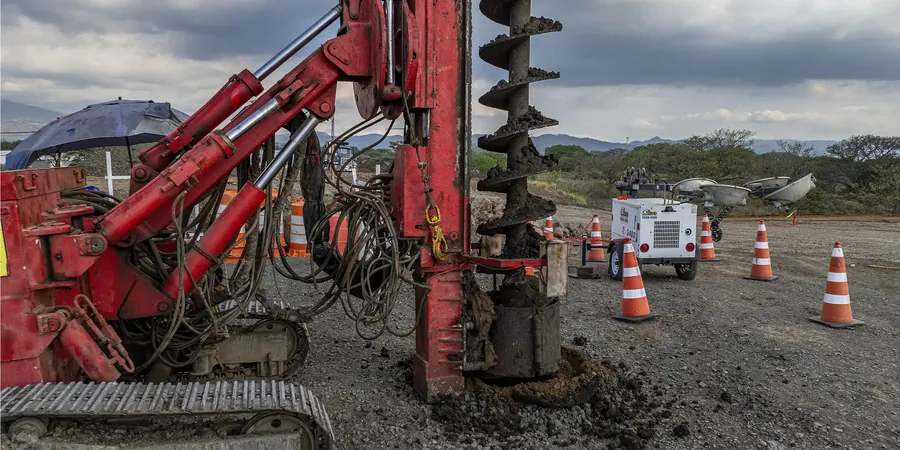
Burlington sits on the shore of Lake Ontario, where near-surface silty clays and loose deltaic sands extend across the urban grid south of the 403. The water table here sits barely 1.5 m down through most of Brant Street to Aldershot. That combination, high groundwater and soft compressible layers, rules out shallow footings for any mid-rise building. Stone column design becomes the practical answer. We size the column grid and gravel gradation to transfer structural loads past the weak crust into the stiffer Halton Till below. At the laboratory, we run grain size checks on the backfill stone to lock in permeability and friction angle before a single vibroflot hits the ground. When the client needs to verify post-installation densification, we bring in CPT testing to compare tip resistance and sleeve friction against the baseline profiles.
A stone column is not a pile. It improves the ground mass, and the design lives in the interaction between stone friction and clay confinement.