GEOTECHNICALENGINEERING
BURLINGTON
HomeIn-Situ TestingField permeability test (Lefranc/Lugeon)

Field Permeability Testing (Lefranc/Lugeon) for Burlington Subsurface Projects

Geotechnical engineering with regional judgment.

LEARN MORE

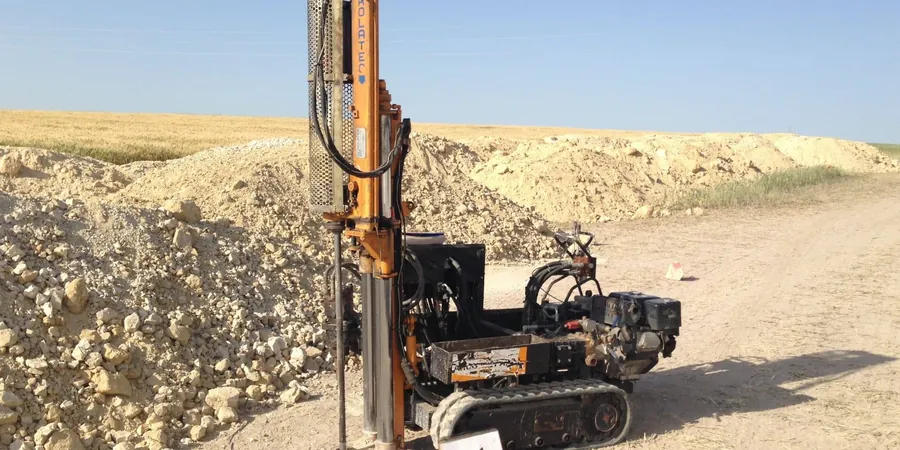
Subsurface water behaves differently beneath Aldershot than it does through the fractured shale of Tyandaga. A standard lab permeameter test often misses the joint-controlled flow paths that govern real drainage rates. In Burlington, where the Queenston Formation underlies much of the city, field permeability testing becomes the only reliable way to quantify hydraulic conductivity at the scale that matters for dewatering design. The Lefranc method handles soil and weathered rock intervals with precision, while the Lugeon test targets discrete fractures in the competent shale bedrock that runs under the Niagara Escarpment's toe. Our team runs these tests using ASTM D4630 procedures, feeding directly into grouting programs and deep excavations stability analyses across Halton Region.

A Lugeon value above 25 typically indicates open fractures that will dominate the site's groundwater regime, demanding a grouting program before any major excavation proceeds.
Our service areas

Methodology and scope

Burlington's growth after the 1950s pushed development from the lakefront up into the escarpment's fractured caprock, creating geotechnical challenges that lab data alone cannot solve. Field permeability testing bridges that gap. A Lefranc test isolates a specific interval in a borehole, measuring constant or falling head response to get a direct k-value for that stratum. The Lugeon test does the same for rock, pumping water under pressure in five stages to calculate Lugeon units and assess fracture dilation. Both methods require careful packer placement and steady-state flow confirmation. Results integrate directly into groundwater models and help determine if grouting is necessary before excavation. The data also feeds slope stability models along the escarpment face, where perched water tables can trigger shallow failures during spring thaw.
Field Permeability Testing (Lefranc/Lugeon) for Burlington Subsurface Projects
Technical reference — Burlington

Local considerations

Burlington sits at roughly 74 meters elevation near the lake, rising to over 200 meters at the escarpment brow. This topographic gradient drives active groundwater movement through the bedrock, and a single unsealed fracture can flood an excavation within hours. In 2014, a slope failure near King Road highlighted how quickly pore pressure can destabilize shale when drainage is insufficient. Field permeability testing de-risks these scenarios. Without it, designers rely on textbook values that often underestimate hydraulic conductivity by an order of magnitude in fractured Queenston shale. The test also identifies confined aquifer layers that can cause basal heave in deep footings. Every dewatering pump specification, every cutoff wall design, and every slope drainage plan in Burlington depends on knowing the real in-situ permeability, not a lab-derived proxy.

Need a geotechnical assessment?

Reply within 24h.

Email: contact@geotechnicalengineering.co

Applicable standards

ASTM D4630-19: Standard Test Method for Determining Transmissivity and Storativity of Low Permeability Rocks, CAN/BNQ 2501-135: Soils — Determination of Permeability by the Lefranc Method, CSA A23.3: Design of Concrete Structures (references for groundwater effects on foundations)

Technical parameters

ParameterTypical value
Test StandardASTM D4630 / CAN/BNQ 2501-135
Test TypesConstant head, falling head, pressure injection
Soil MethodLefranc (open borehole or screened interval)
Rock MethodLugeon (5-stage pressure test in competent rock)
Measurement Range1×10⁻⁷ to 1×10⁻² cm/s
Borehole DiameterNX to HQ (76 mm to 96 mm typical)
Reporting Outputk-value (cm/s) or Lugeon units (Lu)

Frequently asked questions

What is the typical cost range for a field permeability test in Burlington?

A single Lefranc or Lugeon test interval typically falls between CA$940 and CA$1,290, depending on borehole depth, access conditions, and the number of test stages required. A comprehensive program with multiple intervals across several boreholes will scale accordingly. We provide a fixed-price quote after reviewing the site geology and project specifications.

When is a Lugeon test required instead of a Lefranc test?

A Lugeon test is specified when the investigation encounters competent, fractured rock — typically the Queenston Formation shale or limestone of the Niagara Escarpment. The test uses a packer to isolate a section of the borehole and applies water pressure in five stages. This reveals whether fractures are tight, open, or dilate under pressure. Lefranc testing applies to soil, fill, or highly weathered rock where the borehole walls are less stable and a granular filter zone is used.

How long does a field permeability test take on site?

Plan for 45 to 90 minutes per test interval once the borehole is drilled and the packer is set. A Lugeon test takes longer due to the five pressure stages and the need to confirm steady-state flow at each step. A typical single-shift investigation in Burlington can complete three to four test intervals, depending on drilling progress and groundwater response time in the fractured shale.

Location and service area

We serve projects across Burlington and its metropolitan area.

View larger map