GEOTECHNICALENGINEERING
BURLINGTON
HomeIn-Situ TestingField density test (sand cone method)

Field Density Testing with Sand Cone in Burlington — Reliable Compaction Control

Geotechnical engineering with regional judgment.

LEARN MORE

Burlington sits at the western edge of Lake Ontario, where the combination of glacial till, deep clay pockets, and seasonal freeze-thaw cycles makes fill placement a careful exercise in moisture and density management. The Halton Region has seen steady residential and infrastructure growth, and every new subdivision, road widening, or commercial pad built here depends on a clear answer: is the compacted soil dense enough to carry the design load? We run the sand cone density test on trench backfills, utility bedding, and structural fill lifts because the method gives us a direct, physical measurement of in-place density that no nuclear gauge can match when you need defendable data for a municipal inspector. In areas near Bronte Creek or the escarpment, where subgrade conditions shift from sandy loam to stiff silt within a few metres, we often pair the sand cone with a Proctor curve from our lab to establish the reference maximum dry density right before field work begins.

The sand cone test remains the referee method in compaction disputes because nothing replaces a direct volume measurement with a calibrated Ottawa sand.
Our service areas

Methodology and scope

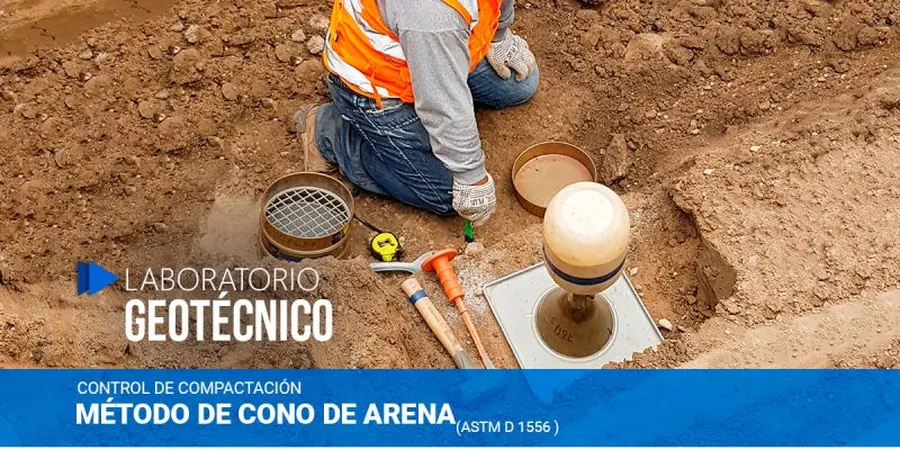
ASTM D1556-15 and ASTM D1557-12e1 govern the sand cone and Proctor procedures we follow on every Burlington project, and the Canadian Foundation Engineering Manual provides the framework for interpreting results against the NBCC and Ontario Building Code requirements for engineered fill. The test is elegantly simple: we excavate a small, undisturbed hole in the compacted layer, weigh the removed soil, measure its moisture content back at our lab, and fill the cavity with calibrated Ottawa sand to determine the hole volume. The dry density we calculate is compared to the laboratory maximum dry density, giving us the percent compaction — typically 95% or 98% of modified Proctor, depending on the specification. Because the sand cone test is sensitive to vibration and loose surface material, we insist on a flat, stable test surface and proper calibration of the sand density before each series of measurements. This level of rigor matters especially in Burlington's silty clay tills, where achieving uniform moisture during compaction can be difficult and a poorly executed test easily misreads the actual density by several percentage points.
Field Density Testing with Sand Cone in Burlington — Reliable Compaction Control
Technical reference — Burlington

Local considerations

The Halton Region's Quaternary stratigraphy — predominantly Halton Till overlying glaciolacustrine silts — creates a compaction risk that is less about bearing failure and more about differential settlement when fill is placed over soft, wet pockets that were not properly identified. In Burlington's older lakeshore neighborhoods, we frequently encounter undocumented fill layers from past construction cycles, and if a sand cone test on a new utility trench shows 92% compaction while the surrounding native ground settles at a different rate, the pavement above will crack within two freeze-thaw seasons. Another subtle risk is moisture content variation during compaction of the region's clayey silt tills: a sand cone test run on a lift that was compacted 2% above optimum moisture may show passing density on the day of testing but later soften as excess pore pressure dissipates. We mitigate this by running frequent field moisture checks with a speedy moisture tester and comparing the in-place dry density against both the peak and the wet-side Proctor points, not just the laboratory maximum.

Need a geotechnical assessment?

Reply within 24h.

Email: contact@geotechnicalengineering.co

Applicable standards

ASTM D1556-15e1 (Sand Cone Method), ASTM D1557-12e1 (Modified Proctor), ASTM D698-12e2 (Standard Proctor), ASTM D2216-19 (Moisture Content), Ontario Building Code (O. Reg. 332/12) reference to NBCC

Technical parameters

ParameterTypical value
Standard methodASTM D1556 / D1556M-15e1
Sand calibrationASTM D1556 Annex A1 (Ottawa sand)
Hole volume rangeTypically 700–1200 cm³ for fine- to medium-grained soils
Min. mass of excavated soil≥ 100 g for moisture content per ASTM D2216
Moisture content methodOven-dry at 110 ± 5 °C or microwave per ASTM D4643
Percent compaction referenceASTM D698 (Standard Proctor) or D1557 (Modified Proctor)
Typical specification (Burlington)95%–98% of modified Proctor for structural fill

Frequently asked questions

What does a sand cone density test cost in Burlington?

For a single sand cone test on a Burlington site, budget between CA$160 and CA$210 per test location, with the rate decreasing when multiple tests are scheduled on the same day. The total project cost depends on the number of lifts and the frequency of testing specified by the geotechnical engineer.

How is the sand cone test different from a nuclear density gauge?

The sand cone method directly measures the volume of excavated soil by replacing it with calibrated sand, while a nuclear gauge infers density from radiation backscatter. The sand cone is considered the referee method on most Ontario projects because it does not require a calibration curve for each soil type and is accepted without debate by municipal inspectors.

How many sand cone tests do I need for my Burlington project?

Frequency is typically specified in the geotechnical report or the compaction specification. A common guideline is one test per lift per 500 m² of compacted area, with a minimum of one test per lift per day for utility trenches and narrow backfills. Our team works directly with your geotechnical engineer to confirm the testing plan.

Can you run a sand cone test on gravel or crushed stone?

ASTM D1556 limits the sand cone method to soils with a maximum particle size of about 2 inches. For clean, open-graded gravels where the hole walls collapse, the test is unreliable. On Burlington road projects, we often use the test on granular base materials up to ¾-inch minus and switch to alternative methods when large stone content is high.

Location and service area

We serve projects across Burlington and its metropolitan area.

View larger map