GEOTECHNICALENGINEERING
BURLINGTON
HomeGround improvement

Ground improvement in Burlington

Geotechnical engineering with regional judgment.

LEARN MORE

Ground improvement in Burlington addresses the challenges of variable overburden soils, including compressible clays and loose silts within the glaciolacustrine deposits of the Lake Ontario basin. Our approach integrates site-specific geotechnical data with the Ontario Building Code and relevant CSA standards to mitigate settlement and enhance bearing capacity. For weak cohesive strata, we often recommend stone column design to provide drainage and reinforcement, while granular zones benefit from vibrocompaction design to achieve target density and stiffness before structural loading.

These techniques are critical for infrastructure and commercial projects such as low-rise foundations, embankments, and slab-on-grade floors where native soils cannot meet performance criteria without treatment. The selection between rigid inclusions or densification methods depends on liquefaction potential and settlement tolerances under service conditions. Combining vibrocompaction design with an appropriate load transfer platform ensures long-term stability for structures on Burlington’s compressible glacial terrain.

Available services

Stone column design

→ Ver detalle

Vibrocompaction design

→ Ver detalle

A common mistake on Burlington jobsites is treating the Halton Till and Queenston Shale interface as a uniform anchor bond zone. The shale here weathers rapidly when exposed to air, dropping allowable bond stress from over 400 kPa to less than half that within hours on a hot July day. Contractors who skip staged pull-out tests end up with anchors that creep under service load, and suddenly a straightforward shoring wall needs costly re-drilling. We run sacrificial test anchors early, measure load-displacement curves, and lock in a bond length that holds through wet fall excavations. For deep cuts near the lake, combining the anchor design with a slope stability analysis catches the global failure wedge that single-anchor checks miss.

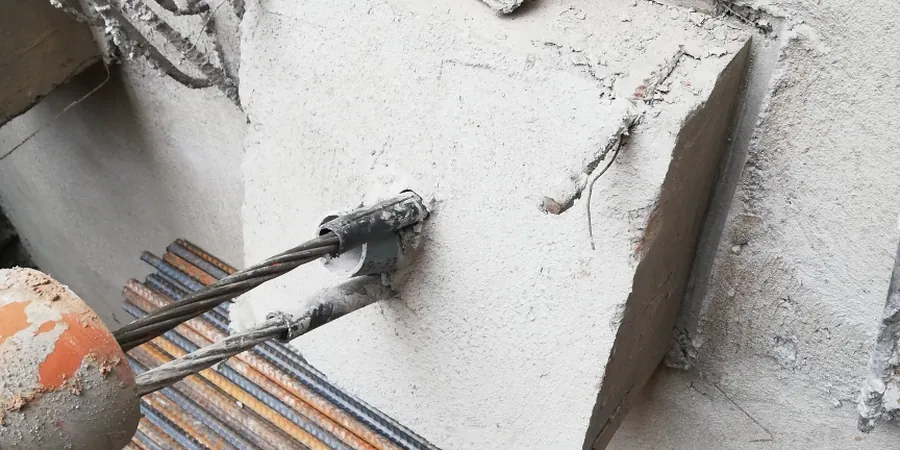
Anchors in weathered Queenston Shale can lose 60% of bond capacity within 24 hours of drilling if left ungrouted — Burlington's escarpment geology demands immediate grout placement.
Our service areas

Methodology and scope

Burlington sits between the Niagara Escarpment and Lake Ontario, which means anchor systems here contend with two drastically different ground profiles. North of the QEW, dolostone bedrock can be reached within 5 m, making passive rock bolts with a short grouted zone practical. South of Lakeshore Road, twenty meters of soft glaciolacustrine clay overlie the shale, requiring active strand anchors with multiple corrosion-protection layers and a free-stressing length that extends well beyond the critical slip circle. We size the unbonded length using actual CPT tip resistance profiles rather than textbook values, because the clay sensitivity in this lakeshore band can exceed 8, triggering strain-softening during lock-off. Where the upper soils contain organics from filled-in creek mouths like Shoreacres, we pair the anchor design with in-situ permeability testing before grouting to avoid hydrofracture through the organic seams.
Anchor Load Testing and Passive/Active Design in Burlington
Technical reference — Burlington

Local considerations

The Aldershot and Roseland areas illustrate the anchor risk gap in Burlington. Aldershot, tucked against the escarpment, has shallow bedrock with occasional karst voids in the Amabel dolostone: an anchor can drill through a cavity, lose grout confinement, and fail a proof test without warning. Roseland sits on deep, compressible clay where anchors interact with adjacent footings on the same street. We map out neighboring foundations and buried utilities before finalizing anchor inclination, because a 45-degree strand tendon can intersect a sanitary lateral at 15 m depth if the stakeout is off by a meter. In both areas, the biggest cost overrun comes from re-mobilizing a drill rig to replace a failed anchor, which is why we pull every test anchor to failure and back-calculate the ultimate bond stress directly from the load-extension data.

Need a geotechnical assessment?

Reply within 24h.

Email: contact@geotechnicalengineering.co

Applicable standards

CSA A23.3:2019 (Annex D — Anchorage), PTI DC35.1-14 (Recommendations for Prestressed Rock and Soil Anchors), FHWA-NHI-10-024 (Drilled Shafts & Anchors), ASTM A416/A416M (Steel Strand), OPSS 903 (Ontario Provincial Standard — Ground Anchors)

Technical parameters

ParameterTypical value
Anchor typeActive strand (15.2 mm 7-wire) or passive solid bar (Grade 150)
Design standardCSA A23.3 Annex D, PTI DC35.1, FHWA GEC No. 4
Bond stress in intact shale350–480 kPa (preliminary); verified by on-site pull-out test
Corrosion protectionClass I (double encapsulation) within 500 m of Lake Ontario
Lock-off load110% of design working load, verified by load cell
Proof test133% of design load, held for 60 minutes per CSA A23.3

Frequently asked questions

What does an anchor pull-out test cost in Burlington?

For a single sacrificial test anchor with mobilization, drill setup, grout, and load testing to failure, plan between CA$1,220 and CA$5,560 depending on depth, access, and whether bedrock is encountered within 10 m.

When is a bonded versus unbonded length required?

A bonded length transfers load to the ground through grout-soil friction. The unbonded length, which must extend past the critical failure surface, is left free to elongate during stressing. In Burlington's deep clay south of the QEW, the unbonded section is typically 8–14 m long to ensure the bond zone sits in competent shale, not in the shear zone.

How do you prevent anchor corrosion near the lake?

Within 500 m of Lake Ontario, we specify Class I double-corrosion protection: corrugated sheathing over the full tendon, epoxy-coated strand, and a factory-grouted encapsulation over the bond length. All anchor heads are recessed into the wall and sealed with a grease-filled cap.

Location and service area

We serve projects across Burlington and its metropolitan area.

View larger map