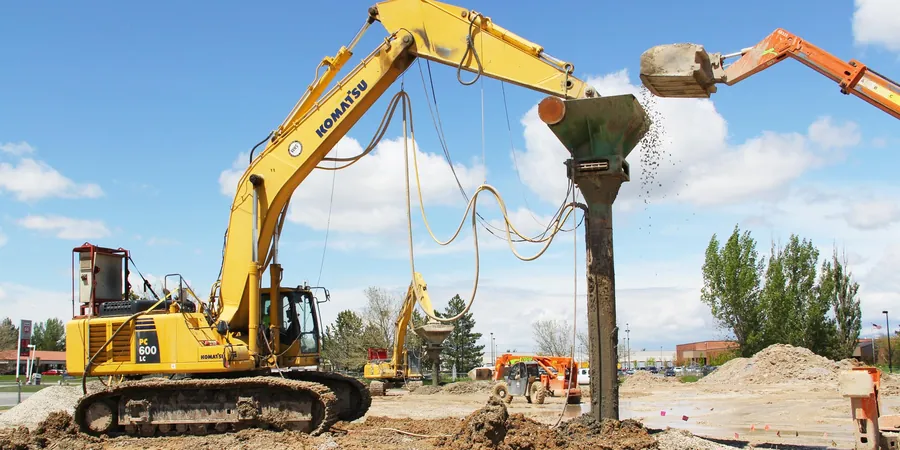
Comparing a project near the Burlington Golf and Country Club with one in the Aldershot neighbourhood reveals a striking contrast in subsurface behavior. The former often rests on dense Halton Till, providing a competent bearing stratum with minimal settlement concerns, while the latter frequently encounters thick sequences of glaciolacustrine silt and fine sand deposited by ancestral Lake Iroquois. These loose, water-saturated granular layers demand a targeted ground improvement strategy, and vibrocompaction design becomes the critical path to achieving a buildable site. Burlington's location between the Niagara Escarpment and Lake Ontario creates these abrupt transitions in soil stratigraphy, where a CPT test can delineate the boundaries between native till and compressible lake-bottom sediments. The design process integrates in-situ test data with a thorough understanding of local Quaternary geology, ensuring that the depth, spacing, and energy input of the vibratory probe are calibrated to the specific grain-size distribution of each formation.
Effective vibrocompaction in Burlington's glaciolacustrine soils requires the design to bridge the gap between ASTM D6066 energy requirements and the real-world fines content revealed by grain-size analysis.