GEOTECHNICALENGINEERING
BURLINGTON
HomeInvestigationCPT (Cone Penetration Test)

CPT Testing in Burlington: Reliable Cone Penetration Data for Foundation Design

Geotechnical engineering with regional judgment.

LEARN MORE

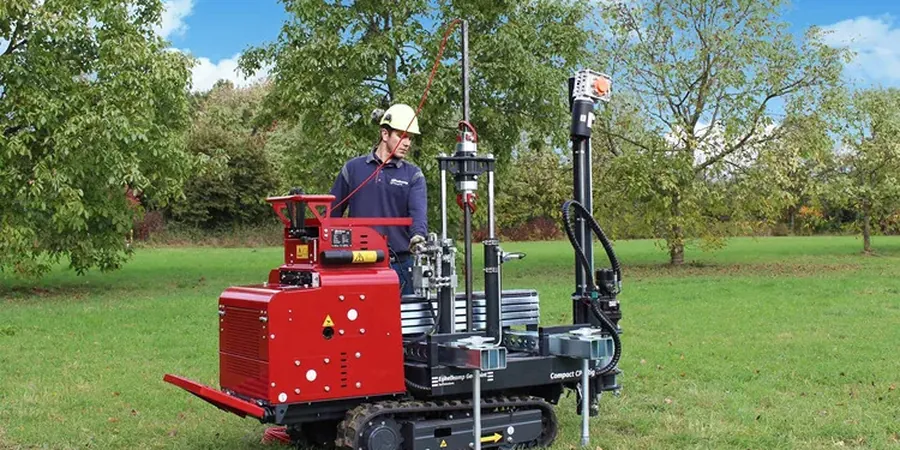
A six-storey condo on Brant Street had a problem last spring. The boreholes showed stiff clay but the settlement numbers didn't add up. We mobilized a 20-tonne CPT truck and pushed through 28 meters of layered Lake Ontario sediments. The friction ratio profile revealed a thin silt seam at 14 meters that the driller missed. That's the value of a continuous penetration record. In Burlington, soil conditions shift fast between the Niagara Escarpment till and the deep basin clays near the lake. A triaxial test on Shelby samples will give you strength, but CPT data shows you where to take those samples in the first place. We run our rigs on tight urban sites and along the QEW corridor, keeping disturbance low and data quality high. For sites with variable fill, combining CPT with SPT drilling gives you the side-by-side comparison geotechnical reviewers want to see.

A CPT sounding in Burlington's lakebed clays reveals more about settlement potential in two hours than a week of lab testing on disturbed samples.
Our service areas

Methodology and scope

Burlington sits on a geological sandwich. The north end has dense Halton Till over shale bedrock, while south of the QEW, thick glaciolacustrine clays dominate. This contrast means a CPT program off Walkers Line looks nothing like one near Spencer Smith Park. Our 20-tonne pusher handles stiff till without pre-drilling, and we switch to a lighter track rig for backyard access in Aldershot. We use a 10 cm² piezocone with u2 shoulder filter to capture pore pressure on the fly. Dissipation tests at the clay-till contact tell us consolidation behavior before we run any lab program. When we hit dense sand lenses, the cone resistance jumps and we flag it for liquefaction analysis using the updated Boulanger-Idriss procedure. On deep clay profiles near the lake, we pair CPT data with laboratory Atterberg limits to calibrate the site-specific soil behavior type chart. Every sounding gets corrected for pore pressure effects and plotted as net cone resistance, sleeve friction, and friction ratio in real time.
CPT Testing in Burlington: Reliable Cone Penetration Data for Foundation Design
Technical reference — Burlington

Local considerations

The Ontario Building Code references NBCC 2015 for seismic site classification, and Burlington's deep clay deposits south of the escarpment often fall into Site Class E. Getting that classification wrong has consequences. A Site Class D assumption when the average shear wave velocity puts you in Class E can add 20% to the design base shear. We've seen it. CPT data feeds directly into the Vs correlation through normalized cone resistance and soil behavior type, giving a continuous velocity profile that picks up soft layers a seismic refraction survey might miss. The other risk is deep-seated settlement in compressible clay. Standard SPT blow counts in soft clay are noisy and unreliable. CPT sleeve friction and pore pressure response give a much cleaner picture of preconsolidation stress and OCR. On one Burlington site near Appleby Line, the CPT showed normally consolidated clay below 18 meters while the upper till looked stiff enough to float a footing. Designing without that deep profile would have led to differential settlement and cracked partitions within five years. We also screen for slope stability concerns on ravine lots where the clay-till contact creates a natural slip surface.

Need a geotechnical assessment?

Reply within 24h.

Email: contact@geotechnicalengineering.co

Applicable standards

ASTM D5778-20 Standard Test Method for Electronic Friction Cone and Piezocone Penetration Testing of Soils, NBCC 2015 Seismic Site Classification (Site Class A through E), Boulanger & Idriss (2014) CPT-Based Liquefaction Triggering Procedure, Robertson (2016) Soil Behaviour Type (SBT) Classification System

Technical parameters

ParameterTypical value
Cone type10 cm² piezocone with u2 shoulder filter
Penetration rate20 mm/s ±5 mm/s per ASTM D5778
Maximum push capacity20 tonnes (200 kN)
Typical depth range15–35 m depending on soil stiffness
Parameters recordedqt, fs, u2, Rf, Bq, Ic (SBT index)
Data acquisitionDigital logging at 2 cm intervals
Pore pressure dissipationt50 monitoring at key layer contacts

Frequently asked questions

What does a CPT test in Burlington typically cost?

For most Burlington sites, CPT cone penetration testing runs between CA$220 and CA$360 per sounding meter, depending on depth, access constraints, and whether you need piezocone or seismic cone data. A typical 25-meter push falls in the mid-range. Tight backyard access or sites requiring a track-mounted mini-rig add mobilization cost. We provide a fixed-price quote after reviewing the site address, expected depth, and any known fill or obstructions.

How does CPT compare to SPT for Burlington's clay soils?

In the soft glaciolacustrine clays common south of the QEW, SPT blow counts often read zero or refusal on gravel stringers, giving a misleading picture. CPT provides a continuous resistance trace at 2 cm intervals. The friction ratio and pore pressure response let us distinguish sensitive clay from silt or till with much more confidence. We still run SPT where you need disturbed samples for index testing, but for settlement and strength profiling, CPT is the sharper tool.

Can you push through the Halton Till in north Burlington?

Yes, within limits. Our 20-tonne rig handles stiff to very stiff till with occasional cobbles. Cone refusal typically happens when the till transitions to Queenston shale bedrock, usually between 8 and 20 meters depth in north Burlington. If you need deeper penetration into rock, we switch to SPT drilling or recommend a combined CPT and borehole program to get both continuous soil data and rock core.

Location and service area

We serve projects across Burlington and its metropolitan area.

View larger map